
Wyandot County Arrest Court Records
The key local rule is simple: court-status questions go to the courts, not the jail. The Wyandot County Corrections page routes Municipal Court matters to Upper Sandusky Municipal Court and Common Pleas matters to the Wyandot County Clerk and court. The Wyandot County Jail may confirm present custody or direct family members to the right office, but formal charges, pleas, hearings, bond orders, warrants, dismissals, and sentencing entries are court records.
That split matters after any Wyandot County arrest. The booking record may list an arresting charge or offense while the prosecutor, law director, or grand jury reviews the police report. The court case then opens through a complaint, information, indictment, amendment, or dismissal. For current custody and intake details, use Wyandot County jail inmate records. For booking photos, use Wyandot County jail mugshots. Court records after a jail arrest answer a different question: what charge was filed and what happened in court.
Wyandot County Court Contacts
Misdemeanor, traffic, and local criminal cases often stay in Upper Sandusky Municipal Court. The court is at 119 N. Seventh Street, Upper Sandusky, OH 43351. Its listed phone numbers are 419.294.3800, 419.294.3809, and 419.209.0474, and pleadings may be routed to pleadings@uppermunicourt.com. The court lists weekday hours of 8:00 a.m. to 4:30 p.m., except holidays, and covers Upper Sandusky plus Carey, Nevada, Wharton, Kirby, and Sycamore.
Felony court records after a Wyandot County arrest may appear through the Wyandot County Clerk of Courts and Common Pleas Legal Department at 109 S. Sandusky Ave., Room 31, Upper Sandusky, OH 43351. The office lists phone (419) 294-1432, fax (419) 294-6414, and weekday hours of 8:30 a.m. to 4:30 p.m. The county prosecutor is Eric J. Figlewicz at 137 S. Sandusky Ave., phone 419-294-5878.
Find Wyandot County Court Records
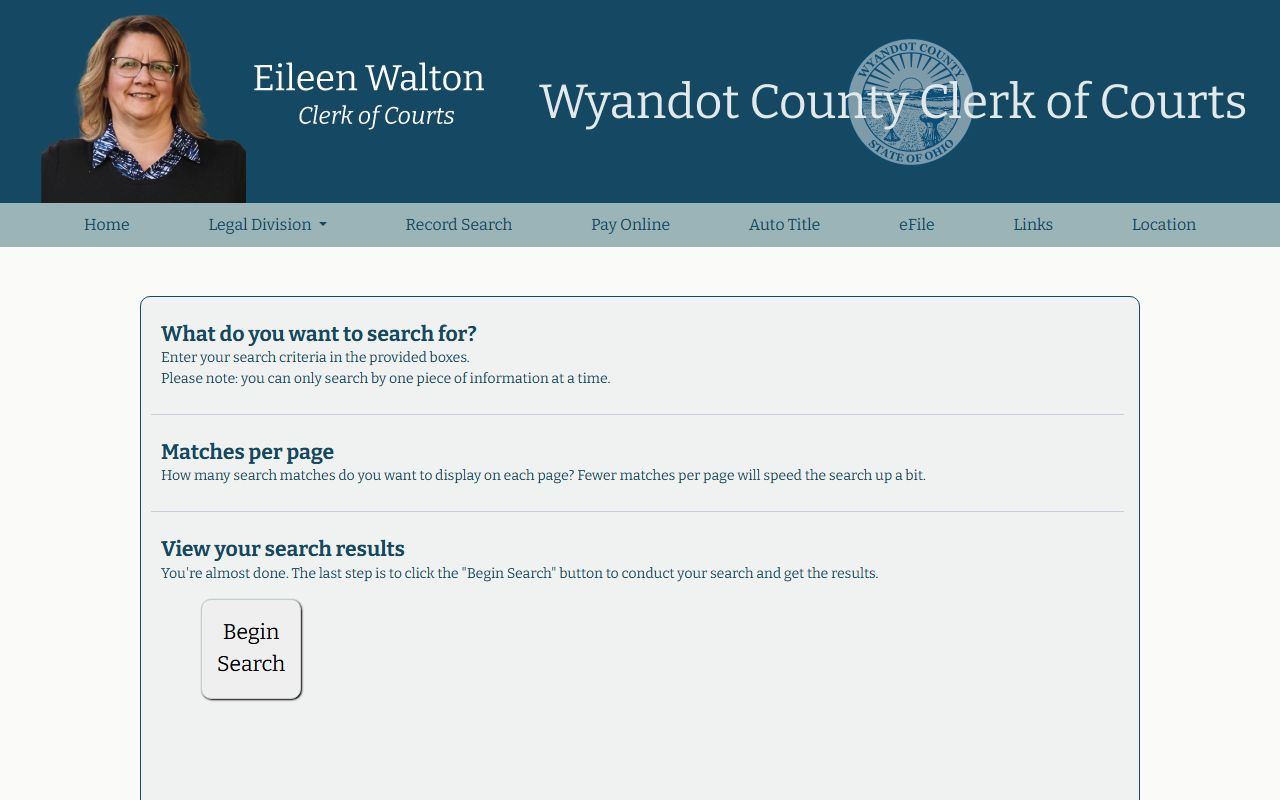
Common Pleas records are searched through the Wyandot County Clerk CaseLook form. The form says to use one search criterion at a time and choose how many matches to return. The related disclaimer warns that online data may lag by at least 24 hours. Verified records require a request to the clerk or review at the office during regular business hours.
The Upper Sandusky Municipal Court CaseLook page uses a disclaimer-and-continue path. Its notice also warns that online records may lag by at least 24 hours or longer, so a same-day Wyandot County arrest may not yet show a complete docket. Call or visit the court when timing, bond, or a hearing date affects release or appearance.
| System | Search Fields | Best Use | Limit |
|---|---|---|---|
| Common Pleas CaseLook | One criterion at a time, plus matches-per-page control | Felony, Common Pleas, bond, docket, and disposition checks | Data can lag at least 24 hours |
| Municipal CaseLook | Disclaimer first, then court search form | Misdemeanor, traffic, preliminary felony, and village cases | Verified records require clerk contact |
| Direct clerk request | Name, case number, date range, court, and record type | Certified or time-sensitive copies | May require mail or in-person review |
The Common Pleas CaseLook search page shows the one-criterion rule and Begin Search button.
Use the online result as an index, then confirm the official record with the clerk when the charge status or bond must be exact.
Wyandot County Arrest Charge Path
The arrest-to-court path starts with booking at the jail or paperwork from the arresting agency. Arresting charges are not final charges. After review, a prosecutor or law director may file a complaint, amend the charge, decline a count, seek an indictment, or move the case into Common Pleas. Misdemeanor and traffic cases generally remain in Municipal Court. Felonies may begin there for early proceedings and then move to Common Pleas through bindover, indictment, information, or another Ohio procedure.
| Document | Who Files It | Common Use | What It Starts |
|---|---|---|---|
| Complaint | Officer, prosecutor, or law director | Misdemeanor cases and some early felony matters | The first filed court charge |
| Information | Prosecutor | Some felony cases when permitted by Ohio procedure | A formal Common Pleas charge without a grand-jury indictment |
| Indictment | Grand jury | Felony charges after grand-jury review | A Common Pleas felony case or new felony counts |
Once filed, the docket may list a case number, charge, statute or ordinance, bond, plea, hearing dates, disposition, sentence, jail-time credit, and court costs. If a Wyandot County defendant is later sent to the Ohio Department of Rehabilitation and Correction, the ODRC Offender Search may show the county of commitment, docket, judge, offense, sentence, and release or parole data. That state prison record supplements the court docket. It does not replace it.
Wyandot County Charge Status
Court records after a jail arrest can change as reports are reviewed, witnesses appear, lab work returns, or plea talks occur. A charge listed at booking may not match the complaint, and a complaint may later be amended or dismissed. Read each count on the docket, not just the case header.
| Status | Plain Meaning | Why It Matters |
|---|---|---|
| Pending | The charge has been filed and has not reached final disposition. | Hearings, bond terms, and court dates still control the case. |
| Amended or reduced | The charge was changed by prosecutor action, plea, or court order. | The filed offense may differ from the original arrest allegation. |
| Dismissed | The court or prosecutor ended that charge. | A dismissal is not the same as a conviction. |
| Nolle prosequi | The prosecutor declined to proceed on that count. | The docket should be checked for remaining counts. |
| Bound over | A municipal felony matter was sent toward Common Pleas. | A new Common Pleas case or indictment may follow. |
Bond and Warrant Records
For a release question, call the Wyandot County Jail or Sheriff's Office at 419-294-2362 first, then confirm the bond with the court that set it. The Clerk homepage states that Ohio Common Pleas clerks accept bonds. Upper Sandusky Municipal Court handles many traffic and criminal bond questions for municipal cases. Because CaseLook data may lag, direct confirmation is the safer path before money is paid or a court appearance is missed.
Ohio pretrial release is governed by ORC Chapter 2937, ORC 2937.22, and Criminal Rule 46 in the Ohio Rules of Criminal Procedure. A court may use personal recognizance, cash, surety, secured bond, or other release conditions. A hold from another court, ODRC, ICE, federal custody, probation, or parole can block release even when a local Wyandot County bond appears payable.
No official Wyandot County web warrant-search portal was found in the county research. Check Municipal and Common Pleas dockets for bench warrants, capias entries, failure-to-appear notes, or bond revocations. For a direct warrant question, call the Sheriff's Office or the issuing court instead of relying on third-party warrant pages.
Wyandot County Charge Comparisons
A Wyandot County arrest record, a court charge, and a conviction are separate records. Treating them as the same thing can lead to false conclusions, especially when charges are dismissed, reduced, or sealed.
| Issue | Charge | Conviction |
|---|---|---|
| Meaning | An accusation filed in court | A guilty plea, verdict, or final finding |
| Stage | Before final disposition | After disposition on that count |
| Proof level | Based on probable cause or charging review | Based on plea or proof beyond a reasonable doubt |
| Docket effect | Can be amended, dismissed, or bound over | Can lead to sentence, jail credit, fines, or supervision |
Ohio also distinguishes sealing from expungement. Sealing limits public access to an eligible record. Expungement is stronger relief for eligible records and is often described as destruction or treatment as if the record no longer exists, subject to Ohio law. Eligibility depends on the case result, offense type, prior record, timing, and court order. A person checking Wyandot County court records after an arrest should read the final disposition and any later sealing entry before treating an old charge as public, current, or final.
| Record Relief | Public Visibility | Wyandot County Effect |
|---|---|---|
| Sealed | Hidden from most public searches | Ask the court and sheriff how the order affects docket and jail display |
| Expunged | More complete removal where Ohio law allows it | The court order drives downstream records changes |
| Not sealed | May remain public unless an exemption applies | Verify with the court of record before relying on online data |
Restricted Wyandot Court Records
ORC 149.43 treats many records kept by public offices as public, but it also lists exemptions and redaction rules. Confidential law-enforcement investigatory records, medical records, trial-preparation records, protected images, body-camera limits, personal information, and juvenile-sensitive material may be withheld or redacted. Court dockets can also lag behind clerk processing.
Important: Online case results are not consumer reports and should not be used for employment, housing, credit, insurance, or other FCRA-covered screening.
For a verified Wyandot County court record after a jail arrest, use the clerk or court that holds the file. Give the person's name, date of birth if known, case number, court, charge, and date range. If the question is only whether the person is still in custody, use the jail. If the question is what charge is pending, what bond was ordered, or whether a conviction was entered, use the court record.